

The Panic of the Puddle
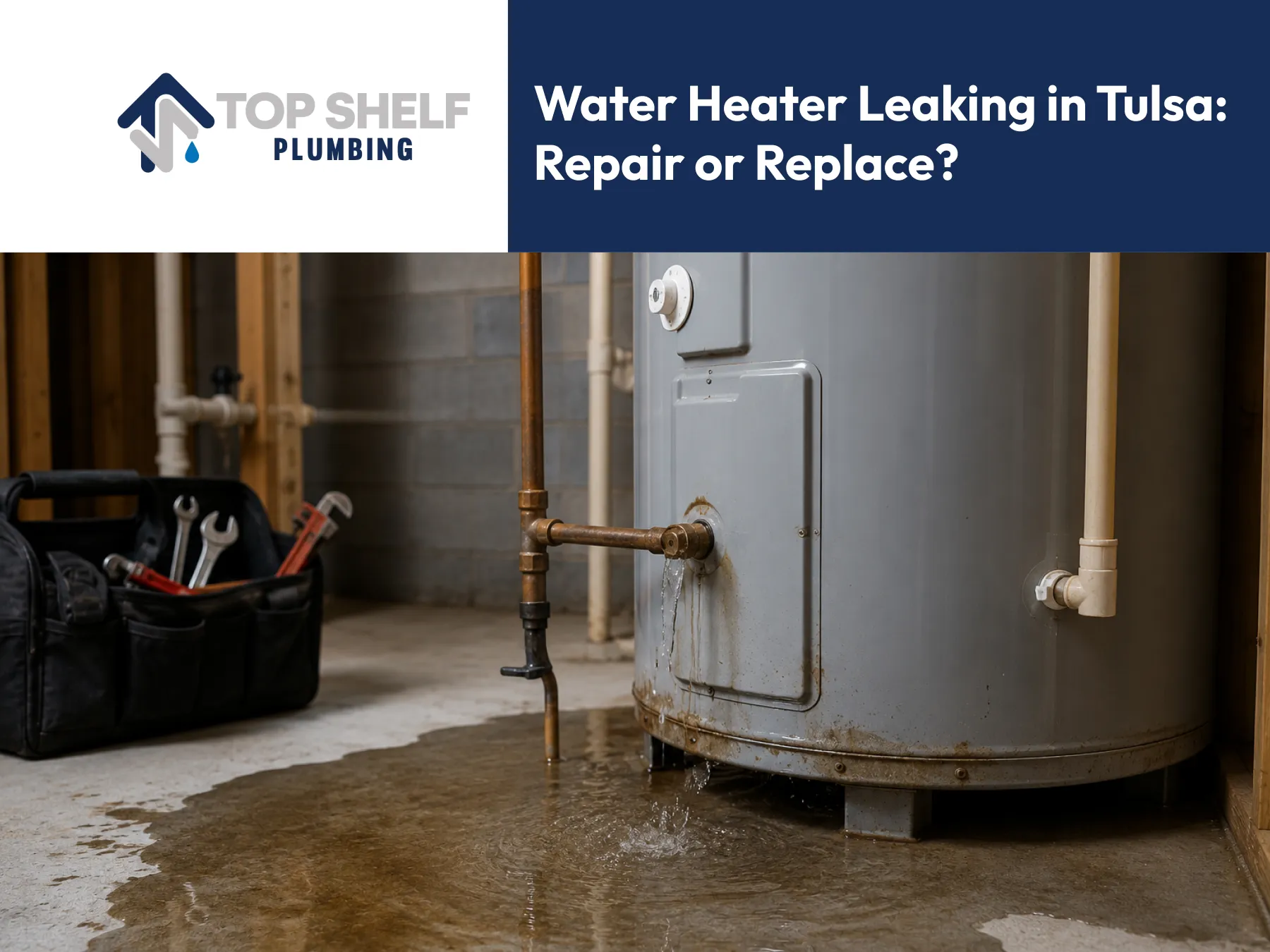
You walk into your garage, utility closet, or basement to grab a tool, and you suddenly hear a soft, rhythmic squishing sound underfoot. You look down, flip on the lights, and your stomach drops. A steady, rusty pool of water is slowly spreading across the floor, creeping directly toward your drywall and personal storage boxes. You trace the moisture back to its source, and there it is: your water heater is actively leaking.
Waking up to a water heater leaking tulsa homeowners experience introduces an instant wave of stress. Your mind immediately jumps to the worst-case scenarios: Is my house going to flood? Am I going to have to take freezing showers? How much is this going to cost me?
In a moment of crisis, you need rapid answers, definitive diagnostics, and a partner you can trust implicitly. The single most important question you have to answer right now is whether that leak can be fixed with an affordable, quick component repair, or if it is a structural warning sign that the entire tank is dead and requires a full replacement.
At Top Shelf Plumbing—proudly known as “America’s Plumbing Team”—we handle water heater emergencies every single day. We don’t believe in using scare tactics, and we operate strictly under the banner of financial honesty. In this comprehensive, easy-to-understand guide, we will walk you through how to execute immediate damage control, how to pinpoint the source of the leak, and exactly how to choose between repair and replacement without breaking the bank.
Damage Control: The Immediate Triage Protocol
Before you spend hours reading articles or looking up prices, you must “stop the bleeding.” A water heater holds 40 to 80 gallons of scalding, highly pressurized water. If the leak escalates, it can cause thousands of dollars in catastrophic structural damage in a matter of minutes.
While you are waiting for a technician from a reliable water heater repair company to arrive, execute these three critical safety steps:
Step 1: Turn Off the Water Supply
Look at the very top of your water heater. You will see two metal pipes entering the tank. One of those pipes (typically labeled with a blue ring or a cold indicator) will feature a shut-off valve.
- If it is a lever-style ball valve, pull the handle a quarter-turn so it sits perpendicular (forming a cross) to the pipe.
- If it is a round wheel-style gate valve, turn it firmly clockwise (righty-tighty) until it stops completely. This cuts off the incoming municipal water pressure feeding the leak.
Step 2: Shut Off the Fuel/Power Source
Never let a water heater run or try to heat up when it is losing water, as this poses an extreme explosion or fire hazard.
- For Gas Units: Locate the gas control dial on the front of the unit (the thermostat box near the bottom). Turn the dial fully to the “Off” or “Pilot” position. Then, close the dedicated gas valve on the yellow or black pipe leading into the unit.
- For Electric Units: Do not touch the water if it is touching electrical wires. Head straight to your home’s main circuit breaker panel, find the switch clearly labeled “Water Heater” (usually a large double-pole breaker), and flip it completely to the “Off” position.
Step 3: Document the Mess
Take a quick video or a few wide-angle photos of the puddle and the surrounding area on your smartphone. If the moisture ends up damaging your drywall, baseboards, or nearby belongings, your homeowners’ insurance adjuster will require this visual proof to process your restoration claim.
Pinpointing the Source: The Repair vs. Replace Matrix
Once the immediate threat is contained, it’s time to play detective. The physical location of the leak is the primary factor that dictates whether your unit is repairable or needs replacement. Clean up the surrounding water with a towel, keep safety in mind, and use a flashlight to see where the moisture is originating.
Scenario A: The Leak is on Top of the Tank (Often Repairable)
If you see water pooling in the small depressions on top of the tank, or dripping down from the copper pipes above, you are in luck.
- The Culprit: The threaded nipples, dielectric unions, or flexible supply lines connecting your home’s plumbing to the water heater have vibrated loose or corroded. Alternately, the temperature and pressure (T&P) relief valve—the safety valve located on the top or side with a long drain tube—may have failed or activated due to excess pressure.
- The Verdict: REPAIR. A licensed plumber can swap out these fittings, reseal the connections, or replace a faulty T&P valve affordably in less than an hour, fully restoring your unit.
Scenario B: The Leak is Coming Out of the Bottom or Seams (Must Replace)
If you wipe down the tank, and you clearly see water weeping directly through the metal jacket seams, out of the lower burner chamber (on gas units), or puddling directly out from beneath the bottom insulation jacket, the news is not good.
- The Culprit: The internal steel tank has completely rusted through. Water heaters are subjected to constant expansion and contraction as they heat up and cool down. Over time, the internal glass lining cracks, allowing water to make direct contact with the steel shell, resulting in oxidative corrosion.
- The Verdict: REPLACE. An internal tank leak cannot be welded, patched, or epoxied. The structural integrity of the pressure vessel is compromised, and you need a full water heater replacement in Tulsaimmediately to prevent a total tank rupture.
The Tulsa Factor: Why Local Tanks Fail Prematurely
If your water heater failed around year 7 or 8, you might feel cheated. After all, manufacturers often claim these appliances can last up to 12 years. In the Green Country area, however, water heaters face a brutal hidden enemy: notoriously hard water.
Tulsa’s municipal water supply contains heavily elevated levels of dissolved minerals, primarily calcium and magnesium. When this water enters your tank and is flash-heated, a chemical reaction forces those minerals to separate from the water. They precipitate out, falling to the bottom of your tank like a slow-motion geological snowstorm.
Over a decade of daily use, this creates a solid, calcified layer of rock at the base of the tank.
- In gas water heaters, this rock layer insulates the water from the burner, forcing the flame to stay on much longer and literally baking the steel bottom of the tank until it becomes brittle and fractures.
- In electric units, the sediment completely buries the lower heating element, causing it to burn out rapidly and accelerating internal rust.
Vetting the Age: The 50% Rule
If you discover a repairable leak (like a faulty thermostat or a bad heating element) but your water heater is quite old, you need to weigh the long-term economics of the fix. At Top Shelf Plumbing, we guide our customers using the standard industry 50% Rule:
“If the cost of repairing your water heater exceeds 50% of the cost of buying a brand-new, high-efficiency unit, and the tank is already past 8–10 years of age, your capital is much better spent on an upgrade rather than a short-term band-aid.”
To check the exact age of your unit, look at the paper manufacturer’s sticker on the side of the tank. Find the serial number. For most major brands, the first four digits represent the week and year (or month and year) it was built. For example, a serial number starting with “0816” typically means it was manufactured in August of 2016. If your tank is past its 10th birthday, its internal sacrificial anode rod is completely depleted, meaning an internal structural leak is inevitably right around the corner.
Why DIY Replacement is an Unacceptable Risk
With a quick trip to a local big-box hardware store, it is incredibly tempting to try and install a new water heater yourself to save a few dollars on labor. We strongly advise against this. A water heater installation is not a standard plumbing task; it is a complex integration of high-pressure infrastructure, high-voltage electricity, and highly combustible natural gas.
- The Carbon Monoxide Threat: If a gas-powered unit’s exhaust venting is pitched at the incorrect angle or uses unapproved materials, deadly, odorless carbon monoxide gas will back-draft directly into your home.
- The Explosion Risk: If a DIYer fails to properly install or accidentally plugs up the Temperature & Pressure (T&P) safety valve, the tank can turn into an unvented bomb, capable of blasting straight through your roof.
- Code and Warranty Compliance: Modern Tulsa municipal building codes mandate strict safety additions, including thermal expansion tanks and proper code-compliant drainage pans. If a DIY installation fails to meet these criteria, the manufacturer’s warranty is instantly voided, and your homeowners’ insurance may outright refuse to cover the resulting water damage.
Water heater leaking right now?
Stop the water, then get a clear answer.
If the leak is coming from a fitting or valve, repair may be possible. If water is coming from the tank body or bottom seam, replacement is usually the safer option. Top Shelf Plumbing can inspect it and explain your choices clearly.
Why Top Shelf Plumbing is Tulsa’s Water Heater Authority
Dealing with a water heater leak paralyzes your home’s daily comfort and threatens your property value. During this high-stress event, you deserve a local service provider that cuts through the chaos with absolute financial honesty, clear communication, and unparalleled execution.
At Top Shelf Plumbing, we are incredibly proud to be America’s Plumbing Team. We approach every single emergency leak call with our three unshakeable core values:
- Service With Honesty: We provide flat-rate, transparent pricing upfront before we ever lift a wrench. If your leak can be safely fixed with a simple $150 valve replacement, that is exactly what we will recommend. We will never use a puddle as an excuse to pressure you into a massive replacement you don’t actually need.
- Service With A Smile: We know you are inconvenienced and stressed about property damage. Our highly trained, background-checked technicians arrive on time, in clean uniforms, with a positive, reassuring attitude. We wear protective shoe covers, utilize heavy drop cloths, and safely haul away your old, heavy tank so you don’t have to lift a finger.
- Service With Integrity: We do things right the first time. Whether we are patching a minor fitting or installing a brand-new, energy-efficient traditional tank or modern on-demand tankless system, we strictly adhere to the highest industry code standards. We back our craftsmanship with robust written warranties, giving your family long-term security.
