

The Ultimate Defender: The Air Gap
When plumbers talk about preventing backflow at the sink, they are almost always referring to an air gap. An air gap is exactly what it sounds like: a physical, empty space of air that breaks a vacuum. Because water cannot jump across open air, this gap makes it physically impossible for contaminated water to siphon backward.
Your kitchen sink utilizes air gaps in two entirely different ways:
1. The Faucet Air Gap (Protecting the City Water)
If there is a massive drop in municipal water pressure (like a fire truck opening a hydrant down the street), a vacuum is created in your home’s water lines. If your kitchen faucet were submerged in a sink full of dirty, soapy water, that vacuum would suck the dirty water directly back into your home’s clean drinking supply. To prevent this, plumbing codes require a physical air gap between the tip of your faucet spout and the “flood level rim” (the absolute top edge) of the sink basin. Even if the sink overflows, the dirty water will spill onto the floor before it can ever touch the faucet spout.
2. The Dishwasher Air Gap (Protecting Your Appliance)
If you look at the back edge of your kitchen sink, you likely have a small, cylindrical metal or plastic dome sitting next to the faucet. This is the dishwasher air gap device.
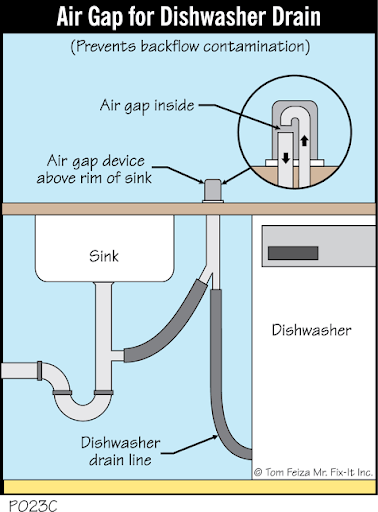
How a dishwasher air gap works. Source: Mr. Fix-It, Tom Feiza
Your dishwasher pumps its dirty wastewater into the exact same drain pipe (or garbage disposal) that your kitchen sink uses. If your sink drain gets severely clogged, the wastewater has nowhere to go. Without an air gap, that contaminated sink water would flow straight down the hose and pool at the bottom of your dishwasher, coating your clean plates in raw bacteria.
The air gap device forces the dishwasher wastewater to travel up above the sink’s flood rim and drop through an open air space before traveling down into the disposal. If the disposal clogs, the backed-up water will spill out of the little dome into your sink basin, physically preventing it from reaching the dishwasher.
Busting the Myth: What the P-Trap Actually Does
When homeowners ask which part of a sink prevents backflow, many instantly point to the curved, U-shaped pipe sitting directly beneath the sink basin. This is called the P-trap.
While the P-trap is a critical safety device, it does not stop the backflow of dirty water. It stops the backflow of toxic gas.
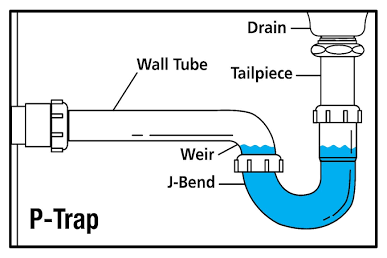
The P-trap utilizes a water seal to block sewer gas. Source: Oatey
Every time you run your faucet, a small amount of water remains trapped in the bottom curve of the P-trap. This standing water acts as an airtight seal. It physically blocks highly toxic, foul-smelling methane and hydrogen sulfide gases from rising out of the municipal sewer, traveling up your pipes, and venting into your kitchen. If you ever smell “rotten eggs” coming from a guest bathroom sink that hasn’t been used in months, it is because the water inside the P-trap has completely evaporated, breaking the protective seal.
Why Sink Backflow Prevention Fails
Gravity-based safeguards like air gaps and P-traps do not have moving mechanical parts, which makes them highly reliable. However, they can still be defeated by blockages and poor installation.
Here is what is happening if you are experiencing dirty water backups:
- The Air Gap is Spilling Water: If water shoots out of the little dome on your sink every time you run the dishwasher, the air gap itself is doing its job—but the hose connecting it to the garbage disposal is clogged with food debris.
- The “High Loop” Failure: If your kitchen lacks an air gap dome on the sink counter, the dishwasher drain hose must be physically strapped as high as possible up underneath the cabinet before dropping down into the drain (known as a “high loop”). If this strap breaks and the hose sags, dirty sink water will instantly flow backward into your appliance.
- Garbage Disposal Knockout Plug: If you just installed a new garbage disposal and your dishwasher won’t drain, the internal plastic “knockout plug” inside the disposal’s dishwasher port was likely left in place. The water is hitting a solid wall and reversing course.
Let America’s Plumbing Team Restore Your Kitchen
A kitchen sink that spits dirty water backward is highly unsanitary and deeply frustrating. You need a contractor who can quickly identify the restriction, clear the line safely, and ensure your protective air gaps are installed strictly to code.
When you call Top Shelf Plumbing to resolve your sink and dishwasher issues, you experience our three core values firsthand:
- Service With Honesty: We provide flat-rate, transparent pricing. We will physically show you where the blockage is located or why your dishwasher hose is failing, and we will give you a firm price before we ever lift a wrench.
- Service With A Smile: We respect your kitchen. Our highly trained technicians arrive in clean uniforms, bring a positive attitude, and use heavy drop cloths under your cabinets to ensure we don’t leave a single drop of dirty water behind.
- Service With Integrity: We don’t apply temporary fixes. Whether we are clearing a dense grease clog in your main line or installing a brand-new, code-compliant air gap device, we execute every repair with premium materials that add lasting value to your home.
Do not let a backed-up sink compromise your family’s health or ruin your dishwasher. Let the local professionals handle the dirty work safely, cleanly, and efficiently.
Call Top Shelf Plumbing today at (844) 984-3984 to schedule your sink diagnostic or drain clearing service. We are ready to restore your home’s comfort with honesty, integrity, and a smile!
